

The August job reports just came out and it exceeded expectations, which is signaling a Federal interest rate hike of at least 0.25%. But why?
It’s largely due to inflation, but because the job reports came higher than anticipated it gives the Fed enough leeway to increase the interest rates without the labor folks yelling at them since increasing the interest rate slows down the economy. If investors don’t get a higher interest rate for the 30 year, then they won’t buy the 30 year bonds.
Here’s the summary of the jobs report for August.
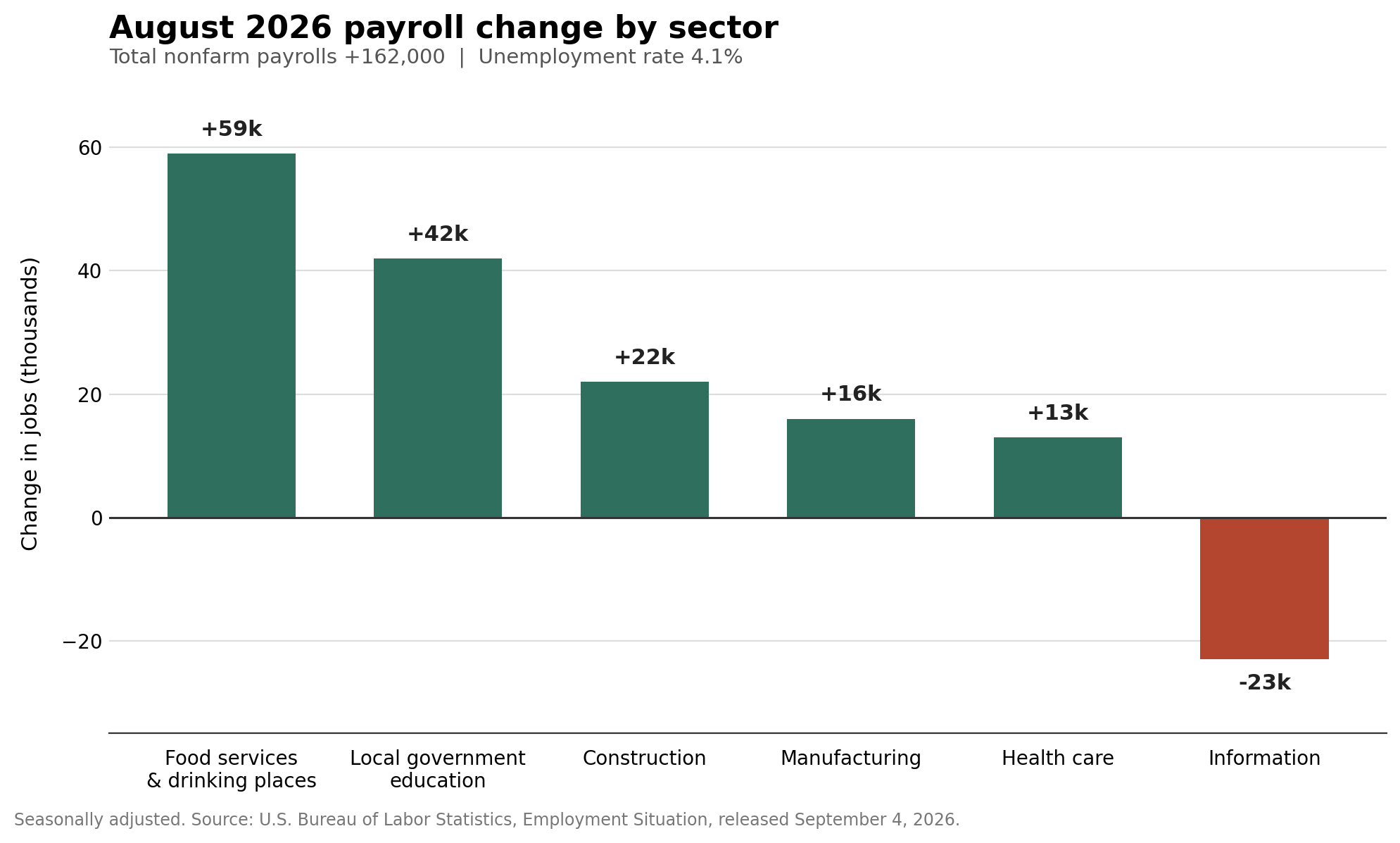
While we can’t completely attribute the job losses in the Information sector to AI, a lot of economists are pointing to that. We can however point to an increase in construction and manufacturing to AI with the increases in data center projects around the US.
The President is pressuring the Fed to lower interest rates because of the job reports or he will stop trading with countries that have a trade deficit with the United States, which the Supreme Court has deemed as a lawful measure by the President during its tariff ruling. This includes countries like China, Mexico, and Vietnam.
The problem is that if the Fed does lower or keep the interest rate unchanged, it most certainly will have adverse effects on the US bond market.
If the Fed cuts, sales of long bonds fall.
The short bonds will rally since the 2-year and T-bills track the Fed rate directly.
Long bonds do the opposite. The Fed's official target is 2% inflation, but it is running at 3.4%. The Fed cutting rates stimulates the economy, which would push prices up. Doing that while you're already missing your target tells investors you've stopped trying to hit it. They stop assuming inflation will return to 2 percent and start planning around 3 percent or more.
So the net result is investors want a higher interest rate to lock their money up for 30 years, because inflation would eat the returns. Higher rates on new bonds means lower prices on the ones you already own.
AI is making it worse.
Cheaper borrowing means more data centers, which means more corporate bonds competing with Treasuries for the same pension and insurance money. And these are winning that competition. Hyperscaler deals are oversubscribed four to one because the balance sheets are stronger than the average corporate borrower and they pay more than Treasuries.
Housing is the biggest concern.
Mortgages price off the 10-year, not the Fed rate. The 30-year fixed is at 6.71 percent, a 19 year high. If long yields rise, mortgage rates rise with them, so a Fed cut could leave buyers worse off than before.
Meanwhile data centers are outbidding homebuilders for labor. Trades moving to data center work are getting 25 to 30 percent higher pay. Commercial electricians are up 9.9 percent year over year against 2.4 percent for the economy.
Texas builders can’t finish homes because Stargate took their electricians.
So demand is frozen by rates and supply is frozen by labor. Nationally, rents are still soft because of the 2024 construction wave. But that pipeline is emptying, and apartments run on the same electricians the data centers are hiring. The pressure is already visible where AI money concentrates: San Francisco rents are up 26 percent year over year and Oakland 15 percent, while Sun Belt metros that overbuilt are still falling.
The fix has to come from Congress.
Everything above points to one place. Long yields are being set by supply, not by the Fed. The Fed cannot fix this. Cutting rates makes the long end worse, not better. Buying bonds means monetizing the deficit and inviting the inflation we are already fighting. The administration can’t fix it either and executive action does not change the borrowing trajectory.
Only Congress sets the budget. And we head into November with a real chance of a divided one, which historically means shutdown fights, continuing resolutions, and no serious work on the deficit. That is the scenario the bond market is pricing. Every month Congress does not act, the market extracts the discipline instead, through higher yields, higher mortgage rates, and housing that stays out of reach.
The specific risk is a split Congress for the next two years after midterms. Republican Senate, Democratic House, Republican administration. (or vice-versa). In that configuration, we get appropriations and must-pass extensions and not much else. No entitlement reform, no revenue package, no work on the primary deficit. That means two more years of issuance against an unchanged fiscal path, and a market that keeps repricing term premium to compensate.